
Graticcio Stauss
A specialist product, little known, that we have always sold. It has been in use for almost a century.
First used for ceilings and suspended ceilings, then for fire protection, today it is used mainly for thin, curved, strong, fire-resistant and earthquake-resistant structures. It is even cited in the fire-fighting technique manuals of the Italian Fire Brigade.
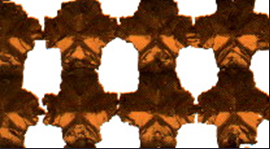
How it is made
A mesh of iron wire with a small cross-shaped brick at every intersection. The cross makes the mortar bond perfectly, and gives the thin structure a strength comparable to that of reinforced concrete.
Technical data
- Mesh
- annealed steel wire, square mesh, 2 cm side
- Crosses
- brick, about 1 cm thick, square holes of about 1 cm
- Weight
- about 5 kg per m²
- Mats
- 100 × 500 cm, equal to 5 m²
- Rolls
- about 20 cm in diameter, 100 cm high, about 25 kg each
How to work it
It bends by hand, cuts with scissors, can be stitched or joined with wire, tied or welded to steel, nailed to wood, stapled or attached to any support.
It is solid: the crumbs of terracotta that come off are usually processing waste, and its strength does not change even if it loses 10/20% of the crosses. The metal is protected by a layer of carbon oxide that slows rusting; for very damp areas, or if you do not want to plaster it, there is a stainless-steel version.
Where it is used
- Thin, strong structures, curved too
- Horizontal: ceilings and suspended ceilings
- Vertical: single or double insulating walls
- Fire-resistant
- Earthquake-resistant
- Ventilated walls
Why it resists fire
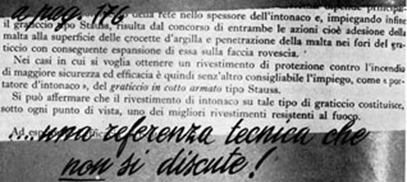
In a fire the plaster does not crack or come away: the wires expand inside their seats, formed in the crosses during firing. Plaster does not come away from fired clay, and the crosses are so small that they do not break with sudden temperature changes. Meshes and expanded metal, on the other hand, push the plaster off as they expand; normal bricks crack.
That is why it has been valued for decades, as the page from the Fire Brigade book reproduced below shows.
Why it resists earthquakes
Graticcio Stauss structures do not “rest” on the others: they are “tied” to them. In an earthquake they do not collapse on their own and, thanks to their dense reinforcement, even when damaged they do not shatter onto the floors below: they bend, staying tied together.
Termo Facciata Stauss
Graticcio Stauss is also used to build the Termo Facciata Stauss, the “perfect coat for the house”: safe, integrated with the house and permanent, because it is made of brick and cement like the house itself.
It becomes one with the cement and creates a cavity that can be filled with the insulation of your choice, or built over insulating panels already glued in place. The facade can be clad in any material, from clinker to granite; the existing cladding can be redone or, as a last resort, removed and reapplied.
Without ruling out other insulation, we suggest Shelder Shield, for its efficiency as an insulator and its durability. And we give you all the information you need for installation.
Want a quote or to know more?
Write to us: our team of experts will advise you on the best solution.